Jeongin Park
PhD applicant for Fall 2027 | Master's Student at Seoul National University
I am interested in Human-AI interaction in extended reality (XR) that augments people’s abilities in everyday activities, situated in the 3D physical world.
I am currently a Master’s student in the HCI Lab at Seoul National University (SNU), advised by Prof. Jinwook Seo. I received my B.S. in Computer Science and Engineering and Mathematical Sciences from Seoul National University, fully funded by the Presidential Science Scholarship.
From January to July 2026, I was a visiting intern at the Augmented Perception Lab at Carnegie Mellon University, collaborating with Prof. David Lindlbauer. I also have research and industry experience at Lunit Inc. and the Max Planck Institute.
My previous work lies at the intersection of Visualization, Human-AI interaction, and wearable interactions and XR.

Publications
DirectVis: Editing Code-Based Interactive Visualization with Direct Manipulation
Jeongin Park, Mingyu An, Hyunseo Yang, Junhyeong Hwangbo, Min Hyeong Kim, Hyeon Jeon, and Jinwook Seo
In 2026 IEEE 19th Pacific Visualization Conference (PacificVis '26)
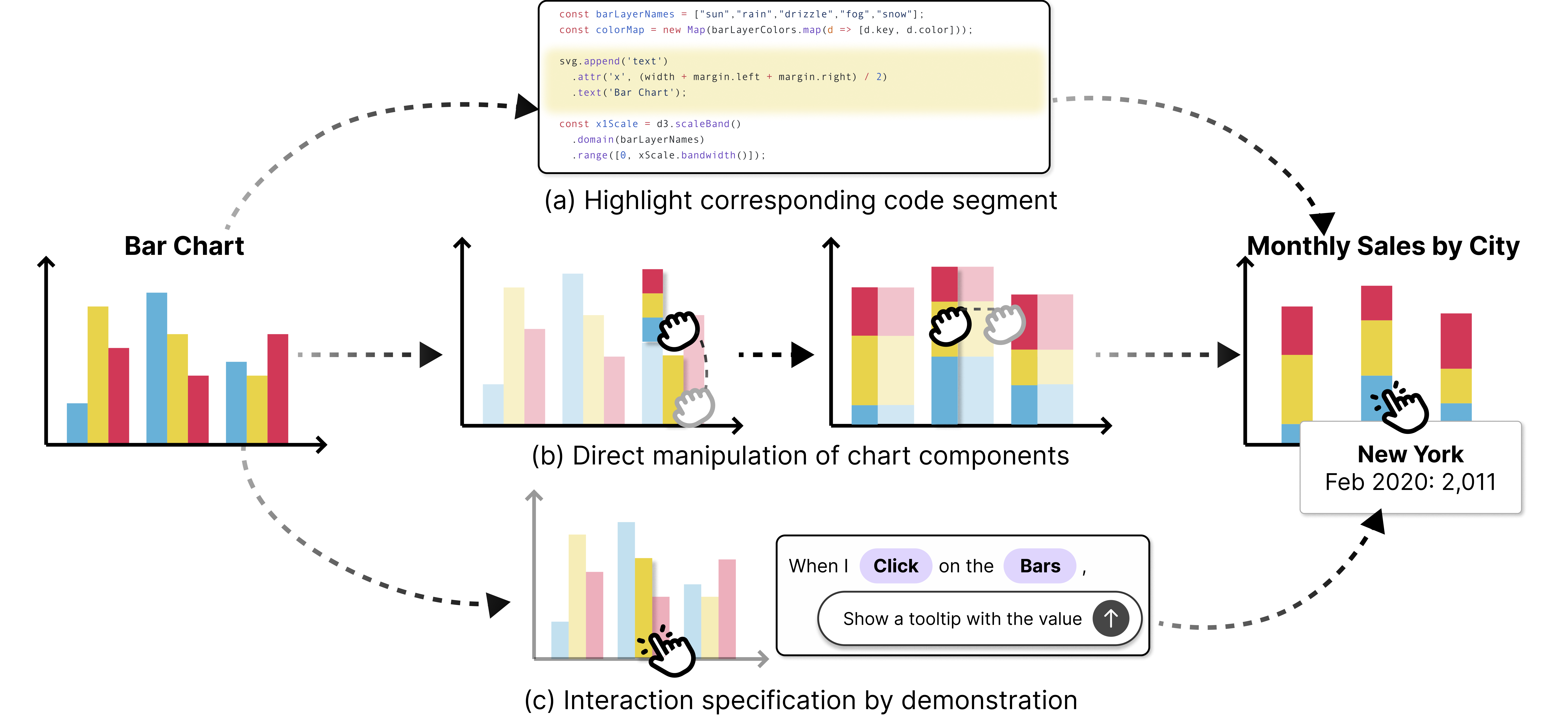
Visualization authoring novices often rely on large language model (LLM)-supported tools for code-based chart editing. However, it can be difficult for novices to precisely articulate what to change and how in natural language, which can make chart editing inefficient; e.g., requiring multiple rounds of iterative revisions. To address this problem, we propose DirectVis, a visualization editing system that integrates direct manipulation with code-based editing. Using DirectVis, users can clarify how a visualization should be edited by directly manipulating chart components. This interaction can be interpreted as users’ demonstration of their intended edits to the system. A user study verifies that our system facilitates the precise delivery of user intent, thereby improving the efficiency of chart editing compared to natural-language-based systems. Based on our findings, we derive design implications for future visualization editing tools.

Stop Misusing t-SNE and UMAP for Visual Analytics
Hyeon Jeon, Jeongin Park, Sungbok Shin, and Jinwook Seo
IEEE Transactions on Visualization and Computer Graphics (VIS 2026)
Misuses of t-SNE and UMAP in visual analytics have become increasingly common. For example, although t-SNE and UMAP projections often do not faithfully reflect the original distances between clusters, practitioners frequently use them to investigate inter-cluster relationships. We investigate why this misuse occurs, and discuss methods to prevent it. To that end, we first review 136 papers to verify the prevalence of the misuse. We then interview researchers who have used dimensionality reduction (DR) to understand why such misuse occurs. Finally, we interview DR experts to examine why previous efforts failed to address the misuse. We find that the misuse of t-SNE and UMAP stems primarily from limited DR literacy among practitioners, and that existing attempts to address this issue -- mostly based on academic papers -- have been ineffective. Based on these insights, we discuss potential future research directions to mitigate the misuse.
Dataset-Adaptive Dimensionality Reduction
Hyeon Jeon, Jeongin Park, Soohyun Lee, Dae Hyun Kim, Sungbok Shin, and Jinwook Seo
IEEE Transactions on Visualization and Computer Graphics (VIS 2025)
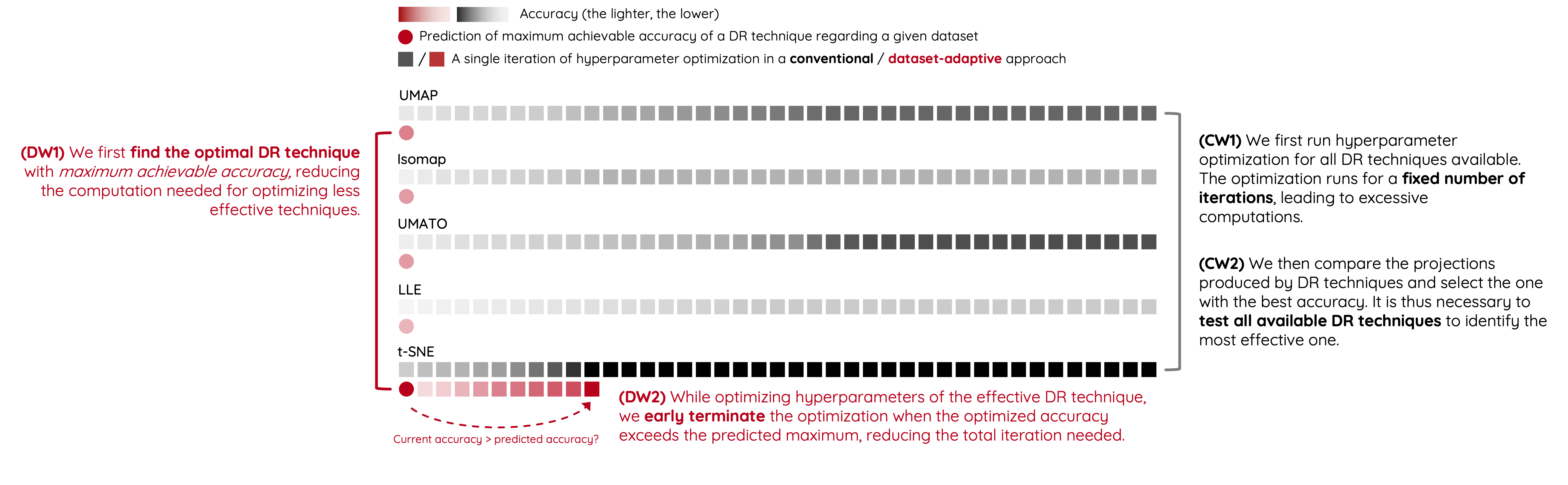
Selecting the appropriate dimensionality reduction (DR) technique and determining its optimal hyperparameter settings that maximize the accuracy of the output projections typically involves extensive trial and error, often resulting in unnecessary computational overhead. To address this challenge, we propose a dataset-adaptive approach to DR optimization guided by structural complexity metrics. These metrics quantify the intrinsic complexity of a dataset, predicting whether higher-dimensional spaces are necessary to represent it accurately. Since complex datasets are often inaccurately represented in two-dimensional projections, leveraging these metrics enables us to predict the maximum achievable accuracy of DR techniques for a given dataset, eliminating redundant trials in optimizing DR. We introduce the design and theoretical foundations of these structural complexity metrics. We quantitatively verify that our metrics effectively approximate the ground truth complexity of datasets and confirm their suitability for guiding dataset-adaptive DR workflow. Finally, we empirically show that our dataset-adaptive workflow significantly enhances the efficiency of DR optimization without compromising accuracy.
Education
Sep 2025 - Present
Seoul National University,
Seoul, South Korea
M.S. in Computer Science Engineering
Mar 2021 - Aug 2025
Seoul National University,
Seoul, South Korea
B.S. in Computer Science Engineering
B.S. in Mathematical Science
Research Experience
Mar 2024 - Present
Human Computer Interaction Lab, Seoul National University,
Seoul, South Korea
Research Assistant
(Advisor: Prof. Jinwook Seo)
Jan 2026 - Jul 2026
Augmented Perception Lab, Carnegie Mellon University,
Pittsburgh, PA, USA
Visiting Intern
(Advisor: Prof. David Lindlbauer)
Dec 2023 - Feb 2024
Lunit Inc.,
Seoul, South Korea
Intern
(Advisors: Jaewoong Shin, Dr. Sergio Pereira)
Sep 2023 - Dec 2023
Max Planck Computing and Data Facility,
Garching bei München, Germany
Intern
(Advisors: Dr. Klaus Reuter, Dr. Markus Rampp)
Mar 2023 - Aug 2023
Visual Computing Lab, Seoul National University,
Seoul, South Korea
Undergraduate Research Opportunities Program
(Advisor: Prof. Hanbyul Joo)